

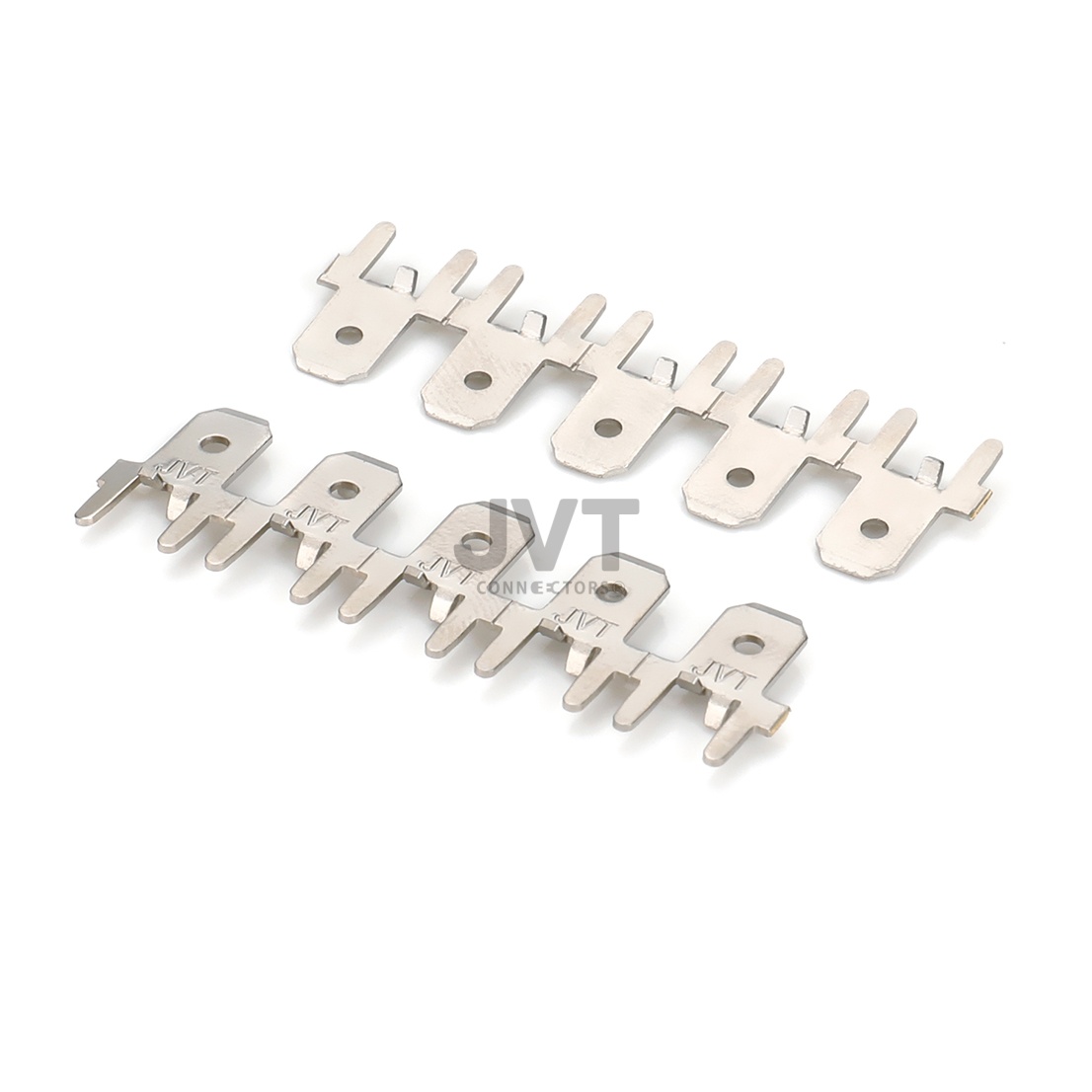
A PV inverter quick connect terminal lives in a place most designers never visit: the low-voltage control section of a cabinet that sits outdoors, bolted to a concrete pad, baking in the afternoon and cold by three in the morning. The power path gets all the attention in solar design, and the signal path gets whatever is left, even though the auxiliary control wiring is what tells the inverter when to start, when to stop, and what the string is doing. On a distributed solar project we supplied for, the customer had been replacing screw terminals during maintenance visits and asked for a wiring method their technicians could service without a screwdriver tray.
This case study explains what the auxiliary control circuit in a solar installation actually carries, why quick connect terminals suit that job, and what the project looked like three years later. It is written for engineers and procurement teams who specify low-voltage wiring for inverters, combiners, and outdoor power cabinets.
What the Auxiliary Circuit in a PV Inverter Quick Connect Terminal Carries
The auxiliary control module inside an inverter cabinet handles signals rather than power. Typical wiring includes status and alarm contacts, communication pair conductors, fan and thermostat circuits, and the low-voltage supply for the monitoring electronics. Currents are small, voltages are low, and the physical challenge is not carrying load. It is making a connection that stays reliable for a decade in a cabinet that breathes hot and cold air every single day.
Two failure modes dominate in this environment, and both of them are mechanical before they are electrical.
- Terminal screw loosening. Repeated thermal cycling expands and contracts the wire, the terminal, and the moulding at different rates. A screw that was correctly torqued at commissioning can lose clamp force over a few hundred cycles, and a loose signal terminal produces intermittent faults that are extremely expensive to diagnose because the inverter may run normally for days between events.
- Service access. Every maintenance visit that requires a screwdriver inside a live cabinet adds time and risk. Quick connect terminations let a technician pull and replace a circuit without disturbing the neighbouring wiring.
There is a third consideration that shows up in specification reviews rather than in the field: fire performance and material compliance. The plastic parts of a terminal used in a power cabinet are expected to meet a recognised flame rating, and the plating on the terminal has to be compatible with the environmental declaration the inverter manufacturer supplies to its own customers.
Why the 187 Series Was the Right Terminal Here
The customer's original arrangement used screw terminal blocks on a DIN rail. That is a perfectly sound engineering choice for a factory, and it becomes a liability in a remote solar installation where the nearest qualified technician is an hour away. Our recommendation was to move the field wiring onto 187 series flame-retardant female terminals, with the male tabs mounted on the board and the harness terminated at the factory.
Factory-terminated harnesses instead of field wiring
When the crimp is made in a controlled process with the correct tooling, the termination quality stops depending on who is standing in the cabinet. The field activity reduces to pushing a housing onto a tab, which removes the torque question entirely.
Tab geometry that resists vibration and thermal movement
A 187 wide flat tab gives a large contact area for a signal termination, and the housing geometry holds the terminal against the tab rather than relying on the wire to keep it in place. On a cabinet mounted outdoors next to a transformer, that mechanical stability is what keeps the signal path continuous.
Materials documentation for the certification file
Because the inverter is shipped to markets with material restrictions, the customer needed RoHS and REACH declarations for every component in the auxiliary circuit. Terminal mouldings are frequently overlooked in those declarations until an auditor asks for them, and having the documentation ready avoids a late surprise in the certification process.
What was supplied for this project
Terminal family: 187 series flat quick connect terminals with mating housings, for the auxiliary control and status wiring inside the inverter cabinet.
Termination method: factory crimped harnesses delivered as sub-assemblies, replacing field screw terminations.
Environment: outdoor cabinet with a wide day-night temperature swing and seasonal humidity, wiring bundled behind the control board.
Documentation: RoHS and REACH statements issued with the shipment for the inverter manufacturer's compliance file.
Three Years in the Field: What the Customer Reported
The figures below are the ones reported for this installation by the customer after the wiring change. They describe this project and this cabinet design.
| Item | Screw terminal blocks | Quick connect wiring |
|---|---|---|
| Outdoor operating life | Baseline | Three years in the outdoor plant with no failure reported |
| Routine maintenance | Torque check on signal terminals | Pull and replace a circuit without disturbing neighbours |
| Thermal cycling | Clamp force dependent on the screw | Contact force set by the terminal spring |
| Crimp quality | Depends on field workmanship | Controlled at the harness factory |
| Compliance paperwork | Collected part by part | Issued with the terminal shipment |
The customer also moved the same terminal family onto a second product line, which is the clearest signal that a component change has worked: nobody has to be asked twice to reuse it.
Why Choose JVT as Your Long-Term Interconnect Partner?
JVT is the brand of Dongguan JVT Connectors Co., Ltd., a connector manufacturer established in Dongguan, Guangdong in 2006. Our 6,500 square metre factory runs its own injection moulding, stamping, and automatic pin insertion lines, backed by more than twenty injection moulding machines, more than twenty stamping presses, and more than fifty automatic pin insertion machines. A branch in Wujiang, Jiangsu serves customers in the east of China. Our management systems hold ISO 9001, ISO 14001, IECQ QC080000, and IATF 16949 certification, and our products are tested by UL and SGS.
Terminals are one of our core product lines rather than an accessory we buy in. The range covers 187, 250, and 110 quick-connect terminals, soldering terminals, substrate terminals, board-in crimp terminals, direct plug terminals, and straight-through terminals, produced on our own stamping and plating processes. Our connectors span nineteen pitch steps from 6.35 mm to 0.60 mm and serve automotive, low-altitude flight, lithium battery 3C, power tool, power module, industrial, consumer, new energy, home appliances, and computer applications.
Much of our business with overseas customers is localization substitution: taking a part number that a design already specifies and reproducing it in our own plant, with the drawings and samples the customer needs to verify equivalence. For solar and energy equipment, the useful entry points are the 187 flat quick-connect terminal page, the broader quick contact terminal range, the full terminal series, and our new energy connector range for the rest of the cabinet.
Frequently Asked Questions About the PV Inverter Quick Connect Terminal
What does a PV inverter quick connect terminal actually connect?
In most inverters it carries auxiliary and control signals: status and alarm contacts, communication conductors, fan and thermostat circuits, and the low-voltage supply for monitoring electronics. The power path out of the inverter uses a different class of connector and is specified separately.
Why do screw terminals loosen in outdoor cabinets?
Thermal cycling. The wire, terminal, and moulding expand at different rates, and the clamp force set at commissioning can relax over hundreds of cycles. A spring terminal maintains contact force independent of that movement, which is why signal wiring in outdoor cabinets increasingly uses crimped quick connect terminations instead of screws.
Which quick connect size suits control wiring?
The 187 series (4.8 mm wide tab) is the usual choice for control and signal circuits, with 250 series used where higher current is involved and 110 series where space is tight. The deciding factor is the tab width your insulator or existing harness specifies, since that determines whether the housing will fit.
Do I need flame-rated material for a terminal in a solar cabinet?
A recognised flame rating on the moulding is normally expected in power equipment, and it will be asked for during certification. Confirm the material rating against the safety file for your product rather than assuming the terminal inherits it.
Can JVT crimp the terminals onto harnesses before shipping?
Yes. Supplying terminated harnesses as sub-assemblies is common for solar and industrial customers, because it moves the crimp into a controlled process and leaves the field technician with a simple push-on task.
If your maintenance team is still torquing signal terminals in outdoor cabinets, a PV inverter quick connect terminal is worth a look. Send the wire gauge, the number of circuits, and the tab width you need, and we will send samples and a crimp specification for your harness house.
See the Quick Contact Terminal Range Get a Crimp Specification